The Lottery and Other Stories
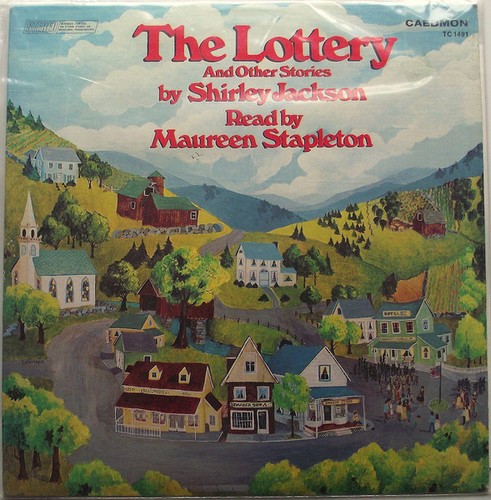
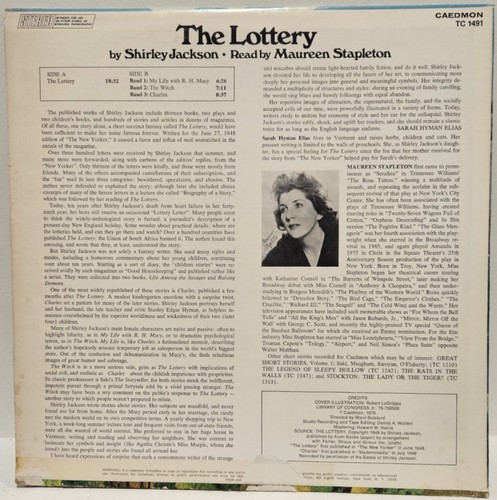
The published works of Shirley Jackson include thirteen books, two plays and two children's books, and hundreds of stories and articles in dozens of magazines. Of all these, one story alone, a short succinct fantasy called The Lottery, would have been sufficient to make her name famous forever. Written for the June 27, 1948 edition of "The New Yorker," it caused a furor and influx of mail unmatched in the annals of the magazine.
Over three hundred letters were received by Shirley Jackson that summer, and many more were forwarded, along with carbons of the editors' replies, from the "New Yorker." Only thirteen of the letters were kindly, and those were mostly from friends. Many of the others accompanied cancellations of their subscriptions, and the "fan" mail fit into three categories: bewildered, speculative, and abusive. The author never defended or explained the story; although later she included choice excerpts of many of the fiercer letters in a lecture she called "Biography of a Story," which was followed by her reading of The Lottery.
Today, ten years after Shirley Jackson's death from heart failure in her forty-ninth year, her heirs still receive an occasional "Lottery Letter." Many people seem to think the widely-anthologized story is factual, a journalist's description of a present-day New England holiday. Some wonder about practical details: where are the lotteries held, and can they go there and watch? Over a hundred countries have published The Lottery; the Union of South Africa banned it. The author found this amusing, and noted that they, at least, understood the story.
But Shirley Jackson was not solely a fantasy writer. She used many styles and modes, including a humorous commentary about her young children, continuing over about ten years. Starting as a sort of diary, the "children stories" were received avidly by such magazines as "Good Housekeeping" and published rather like a serial. They were collected into two books, Life Among the Savages and Raising Demons.
One of the most widely republished of these stories is Charles, published a few months after The Lottery. A modest kindergarten anecdote with a surprise twist, Charles is a pattern for many of the later stories. Shirley Jackson portrays herself and her husband, the late teacher and critic Stanley Edgar Hyman, as helpless innocents overwhelmed by the superior worldliness and wickedness of their two (later four) children.
Many of Shirley Jackson's main female characters are naive and passive: often to highlight hilarity, as in My Life with R. H. Macy, or to dramatize psychological terror, as in The Witch. My Life is, like Charles, a fictionalized memoir, describing the author's hopelessly miscast temporary job as salesperson in the world's biggest store. Out of the confusion and dehumanization in Macy's, she finds rebellious images of great humor and sabotage.
The Witch is in a more serious vein, grim as The Lottery with implications of social evil, and realistic as Charles about the childish impatience with proprieties. Its classic predecessor is Saki's The Storyteller, for both stories mock the indifferent, impotent parent through a primal fairytale told by a vivid passing stranger. The Witch may have been a wry comment on the public's response to The Lottery - another story to which people weren't prepared to relate.
Shirley Jackson wrote stories about stories. Her subjects are manifold, and never found too far from home. After the Macy period early in her marriage, she rarely met the modern world on its own competitive terms. A yearly shopping trip to New York, a week-long summer lecture tour and frequent visits from out-of-state friends, were all she wanted of world contact. She preferred to stay in her huge house in Vermont, writing and reading and observing her neighbors. She was content to insinuate her symbols and insight (like Agatha Christie's Miss Marple, whom she loved) into the people and stories she found all around her.
I have heard expressions of surprise that such a consummate writer of the strange and macabre should create light-hearted family fiction, and do it well. Shirley Jackson devoted her life to developing all the facets of her art, to communicating more deeply her personal images into general and meaningful symbols. Her integrity demanded a multiplicity of structures and styles: during an evening of family carolling, she would sing blues and bawdy folksongs with equal abandon.
Her recurring images of alienation, the supernatural, the family, and the socially accepted evils of our time, were powerfully illustrated in a variety of forms. Today, writers study to imitate her economy of style and her ear for the colloquial. Shirley Jackson's stories edify, shock, and uplift her readers, and she should remain a classic voice for as long as the English language endures. - SARAH HYMAN ELIAS
Sarah Hyman Elias lives in Vermont and raises herbs, children and cats. Her present writing is limited to the walls of preschools. She, as Shirley Jackson's daughter, has a special feeling for The Lottery since the fee that her mother received for the story from "The New Yorker" helped pay for Sarah's delivery.